Blog: COVID & mRNA Vaccine News

28/May/23
NAC-Bromelain-2.jpg

We have two important findings to share today about potential nutritional solutions against clotting and spike protein particles. First, a study published in 2021 has suddenly gone viral over the last two days as someone realized it showed how the combination of bromelain and acetylcysteine (both commonly known in the supplement industry) may inactivate the spike protein by altering its morphology, rendering it unable to attack cells in the body.

The study is titled, “The Combination of Bromelain and Acetylcysteine (BromAc) Synergistically Inactivates SARS-CoV-2.”

It was published in the journal Viruses and appears on Researchgate.net as well as other science article indexing hubs. The full text of the article is available to the public for free.

Authored by a group of researchers — with Ahmed Mekkawy the lead researcher — the study looked at how bromelain and acetylcysteine — also known as the supplement form NAC — alters the glycoproteins of the spike protein. The following chart shows changes in the opacity of SARS-CoC-2 cell cultures upon exposure to different concentrations of the BromAc nutrition combination: (note that the micrograms per mL means ppm, so these are fairly low concentrations yet still have a measurable impact):
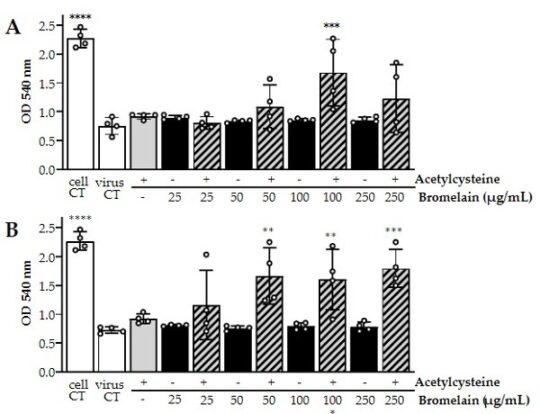
Figure 2.Cell lysis assays demonstratedin vitroinactivation potential of Acetylcysteine and Brome-lain combined (BromAc) against SARS-CoV-2. Cell viability was measured by cell staining withNeutral Red, where optical density (OD) is directly proportional to viable cells. Low OD wouldsignify important cell lysis due to virus replication.

The conclusion of the study explains how this combination of Bromelain and Acetylcysteine alters the structure of the SARS-CoC-2 glycoproteins, rendering them unable to attack human cells.

The combination of Bromelain and Acetylcysteine, BromAc, synergistically inhibited the infectivity of two SARS-CoV-2 strains cultured on Vero cells. Protein con?rmation and its molecular properties are dependent on its structural and geometric integrity, which are dependent on both the peptide linkages and disul?de bridges. Acetylcysteine, as a good reducing agent, tends to reduce the disul?de bridges and hence alter the molecular properties of most proteins. This property has been widely exploited in the development of several therapies (chronic obstructive pulmonary disease, allergic airways diseases,cystic ?brosis, pseudomyxoma peritonei, etc.) [20,23–27]. More recently, Acetylcysteine has been used in the development of therapies for respiratory infections such as in?uenza and COVID-19 [28–30], where the integrity of the spike protein is vital for infection [12,13]. A hypothesized mechanism of action could be the unfolding of the spike glycoprotein and the reduction of its disul?de bonds.

A direct mechanical action against this spike protein is a different treatment strategy in comparison to most of the existing antiviral drugs, which prevents viral entry in host cells rather than targeting the replication machinery. BromAc acts as a biochemical agent to destroy complex glycoproteins. Bromelain’s multipotent enzymatic competencies, dominated by the ability to disrupt glycosidic link-ages, usefully complement Acetylcysteine’s strong power to reduce disul?de bond.

The potential of BromAc on SARS-CoV-2 spike and envelope proteins stabilized by disul?de bonds was examined and found to induce the unfolding of recombinant spike and envelope proteins by reducing disul?de stabilizer bridges. BromAc also showed an inhibitory effect on wild-type and spike mutant SARS-CoV-2 by inactivation of its replication capacity in vitro. Hence, BromAc may be an effective therapeutic agent for early SARS-CoV-2infection, despite mutations, and even have potential as a prophylactic in people at high risk of infection.

Importantly, it should be noted that these tests were carried out in vitro, and there have not been any human clinical trials on this combination that I’m aware of, since the NIH would never fund anything other than Big Pharma drugs and vaccine research. Consider the information presented here as a theoretical route action that warrants further exploration.

Nevertheless, given that bromelain and acetylcysteine are widely consumed as nutritional supplements right now — and are readily available and affordable — these solutions warrant consideration as low-cost, low-risk interventions that may prove to help save lives. (Adams, 2023).

The full research paper is available at: https://www.researchgate.net/publication/349850528_The_Combination_of_Bromelain_and_Acetylcysteine_BromAc_Synergistically_Inactivates_SARS-CoV-2


NOTE FROM PLANT MEDS RX INC:

Patent Pending (#17/815,878) AcuteShield® Supplements were developed to inhibit mRNA spike proteins from attaching to cells, penetrating cell membranes (infiltration), and replicating inside the cells causing severe damage! Protection starts by stopping the mRNA spike proteins from attaching to the cells. After that, penetration and replication cannot happen.

The AcuteShield Vanquish® formula includes N-acetylcysteine (NAC) and Bromelain.

AcuteShield Vanquish®
“Supports Vaccinated Health®”
The nutraceutical composition of AcuteShield Vanquish® wherein the composition comprises N-acetylcysteine, Bromelain, Vitamin D3, Vitamin K2, Quercetin, Nigellin Sativa/Thymoquinone, Magnesium, Sulforaphane, Glutathione, Zinc, Piperine, Curcumin, Astaxanthin, Nattokinase, and Pyrroloquinoline Quinone (PQQ).
Spike Protein, Central Nervous System, Mitochondria, and Immune System Modes of Action.

https://acuteshield.com 

Read the Scientific Research


Citation
(Adams, 2023). Natural News: Breakthrough nutritional solutions discovered that may HALT CLOTTING and UNFOLD spike proteins. Retrieved on 05/28/23 online at https://www.naturalnews.com/2023-01-17-nutritional-solutions-discovered-halt-clotting-unfold-spike-proteins.html

02/Feb/23
Vitamin-K-Benefits.jpg

8 Science-backed health benefits of vitamin K
Wednesday, February 01, 2023 by: Olivia Cook

Vitamin K exists naturally in two forms – vitamins K1 and K2.

Vitamin K1, or phylloquinone, is the primary dietary form found in leafy greens like broccoli, Brussels sprout, cabbage, collard, kale, lettuce and spinach; and in fruits like avocado, banana, grape, kiwi and prune.

Vitamin K2, or menaquinone, is found in small amounts in high-fat dairy products from grass-fed cows and egg yolks; liver and other organ meats; and fermented foods like cheese miso, natto and sauerkraut.

Studies show that vitamin K can help do the following:

Curb progress of aortic valve calcification
A study published in the journal Circulation has indicated that vitamin K2 (menaquinone-7) reduced the progression rate of aortic valve calcification in patients with aortic stenosis, a condition that occurs when the aortic valve narrows and blood cannot flow normally.

Inhibit tumor growth and cancer cell activity
A study published in the journal Nutrients has reported on the exemplary effects of vitamin K on breast, cervical and ovarian cancers, which included tumor growth inhibition, inhibition of cancer cell activity, inhibition of tumor growth, reactive oxygen species (ROS) generation/production and induction of apoptotic cell death.

Regulate process of blood coagulation
Without vitamin K, our bodies will not be able to control clot formation. Vitamin K helps to regulate the process of blood coagulation by assisting in the conversion of certain coagulation factors into their mature forms.

Vitamin K helps to make four of the 13 proteins needed for blood clotting, which stops wounds from continuously bleeding so they can heal.

Promote bone health
A study published in the International Journal for Vitamin and Nutrition Research has indicated that vitamin K2 promotes healthy bone mineral density by carboxylating osteocalcin, a protein that binds calcium in bones.

Researchers concluded that in postmenopausal women who had experienced hip or vertebral compression fractures, supplemented with either five or 45 milligrams/day of vitamin K2 (menaquinone-4) reduces undercarboxylated osteocalcin to concentrations typical of healthy, pre-menopausal women.

Boost cardiovascular health
A study published in the Journal of the American Heart Association indicated that improving vitamin K status boosts cardiovascular health by reducing arterial stiffness and improving blood pressure.

Among 53,372 Danish citizens, aged 52-60 years, participants with higher intakes of vitamin K had a 21 percent lower risk of an atherosclerotic cardiovascular disease-related hospitalization.

Hinder aging-related changes in brain
“Vitamin K2 demonstrated a very promising impact in hindering aging-related behavioral, functional, biochemical and histopathological changes in the senile aging brain,” said Dr. Mohamed El-Sherbiny of AlMaarefa University in Saudi Arabia, senior author of a study published in SciTechDaily.

Reduce diabetes risk and improve insulin sensitivity
Researchers of a study published in the journal Nutrients have indicated that supplementation of vitamin K reduces the risk of diabetes mellitus and improves insulin sensitivity.

Observation studies in humans showed the following results:

Healthy young male participants with higher dietary vitamin K intake showed better insulin response and glucose tolerance.
Dietary intake of both vitamin K1 and vitamin K2 was associated with a reduced risk of Type-2 diabetes mellitus in adult men and women.

Higher circulating vitamin K1 may be causally related to a lower risk of Type-2 diabetes mellitus, highlighting the importance of sufficient phylloquinone intake in the human diet.
Intervention studies in humans showed the following results:

Vitamin K1 supplementation had a protective effect on the progression of insulin resistance in older men.

Vitamin K1 supplementation had beneficial effects on glycemic status and insulin sensitivity in premenopausal and prediabetic women.
Short-term vitamin K2 supplementation improved the insulin response after an oral glucose challenge in young men.

Boost prostate health
Researchers of a study published in The American Journal of Clinical Nutrition have associated higher levels and intake of vitamin K2 with lower prostate cancer risk and vitamin K2 deficiency has been found in most men with aggressive prostate cancers.

Citation
(Cook, 2023). Natural News: 8 Science-backed health benefits of vitamin K. Retrieved on 2/2/23 online from https://www.naturalnews.com/2023-02-01-8-science-backed-health-benefits-vitamin-k.html

Note:

These ingredients are recommended by the FLCCC and World Council for Health and included in the product AcuteShield Vanquish® to Detox Spike Proteins from your body may help people who have been vaccinated improve or regain their health if suffering from new health issues that started after getting vaccinated.

The nutraceutical composition of AcuteShield Vanquish® wherein the composition comprises Vitamin D3, Vitamin K2 MK-7 (100mcg), Quercetin, Bromelain, Nigellin Sativa/Thymoquinone, Magnesium, Sulforaphane, N-acetylcysteine, Glutathione, Zinc, Piperine, Curcumin, Astaxanthin, and Pyrroloquinoline Quinone (PQQ). https://acuteshield.com/product/acuteshield-vanquish/


ALL THINGS COVID AND mRNA VACCINES

Our bodies are made up of approximately 30 trillion cells. COVID and mRNA Vaccine Spike Proteins attach to body organ cells, penetrate cell membranes, and replicate inside your cells causing cell damage and inflammation, resulting in side effects and long-term disease.

Learn what goes on in your body when you get COVID or are vaccinated so you can optimize your immune system to protect your body organ cells.

Subscribe to Receive Research, Articles, and Solutions that Keep you Safe!

You have successfully subscribed to the newsletter

There was an error while trying to send your request. Please try again.

Plant Meds RX Blog will use the information you provide on this form to be in touch with you and to provide updates and marketing.
Verified by MonsterInsights