
Blog: COVID & mRNA Vaccine News

28/May/23
NAC-Bromelain-2.jpg

We have two important findings to share today about potential nutritional solutions against clotting and spike protein particles. First, a study published in 2021 has suddenly gone viral over the last two days as someone realized it showed how the combination of bromelain and acetylcysteine (both commonly known in the supplement industry) may inactivate the spike protein by altering its morphology, rendering it unable to attack cells in the body.

The study is titled, “The Combination of Bromelain and Acetylcysteine (BromAc) Synergistically Inactivates SARS-CoV-2.”

It was published in the journal Viruses and appears on Researchgate.net as well as other science article indexing hubs. The full text of the article is available to the public for free.

Authored by a group of researchers — with Ahmed Mekkawy the lead researcher — the study looked at how bromelain and acetylcysteine — also known as the supplement form NAC — alters the glycoproteins of the spike protein. The following chart shows changes in the opacity of SARS-CoC-2 cell cultures upon exposure to different concentrations of the BromAc nutrition combination: (note that the micrograms per mL means ppm, so these are fairly low concentrations yet still have a measurable impact):
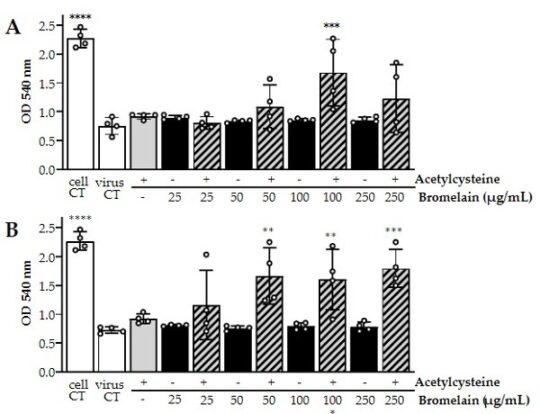
Figure 2.Cell lysis assays demonstratedin vitroinactivation potential of Acetylcysteine and Brome-lain combined (BromAc) against SARS-CoV-2. Cell viability was measured by cell staining withNeutral Red, where optical density (OD) is directly proportional to viable cells. Low OD wouldsignify important cell lysis due to virus replication.

The conclusion of the study explains how this combination of Bromelain and Acetylcysteine alters the structure of the SARS-CoC-2 glycoproteins, rendering them unable to attack human cells.

The combination of Bromelain and Acetylcysteine, BromAc, synergistically inhibited the infectivity of two SARS-CoV-2 strains cultured on Vero cells. Protein con?rmation and its molecular properties are dependent on its structural and geometric integrity, which are dependent on both the peptide linkages and disul?de bridges. Acetylcysteine, as a good reducing agent, tends to reduce the disul?de bridges and hence alter the molecular properties of most proteins. This property has been widely exploited in the development of several therapies (chronic obstructive pulmonary disease, allergic airways diseases,cystic ?brosis, pseudomyxoma peritonei, etc.) [20,23–27]. More recently, Acetylcysteine has been used in the development of therapies for respiratory infections such as in?uenza and COVID-19 [28–30], where the integrity of the spike protein is vital for infection [12,13]. A hypothesized mechanism of action could be the unfolding of the spike glycoprotein and the reduction of its disul?de bonds.

A direct mechanical action against this spike protein is a different treatment strategy in comparison to most of the existing antiviral drugs, which prevents viral entry in host cells rather than targeting the replication machinery. BromAc acts as a biochemical agent to destroy complex glycoproteins. Bromelain’s multipotent enzymatic competencies, dominated by the ability to disrupt glycosidic link-ages, usefully complement Acetylcysteine’s strong power to reduce disul?de bond.

The potential of BromAc on SARS-CoV-2 spike and envelope proteins stabilized by disul?de bonds was examined and found to induce the unfolding of recombinant spike and envelope proteins by reducing disul?de stabilizer bridges. BromAc also showed an inhibitory effect on wild-type and spike mutant SARS-CoV-2 by inactivation of its replication capacity in vitro. Hence, BromAc may be an effective therapeutic agent for early SARS-CoV-2infection, despite mutations, and even have potential as a prophylactic in people at high risk of infection.

Importantly, it should be noted that these tests were carried out in vitro, and there have not been any human clinical trials on this combination that I’m aware of, since the NIH would never fund anything other than Big Pharma drugs and vaccine research. Consider the information presented here as a theoretical route action that warrants further exploration.

Nevertheless, given that bromelain and acetylcysteine are widely consumed as nutritional supplements right now — and are readily available and affordable — these solutions warrant consideration as low-cost, low-risk interventions that may prove to help save lives. (Adams, 2023).

The full research paper is available at: https://www.researchgate.net/publication/349850528_The_Combination_of_Bromelain_and_Acetylcysteine_BromAc_Synergistically_Inactivates_SARS-CoV-2


NOTE FROM PLANT MEDS RX INC:

Patent Pending (#17/815,878) AcuteShield® Supplements were developed to inhibit mRNA spike proteins from attaching to cells, penetrating cell membranes (infiltration), and replicating inside the cells causing severe damage! Protection starts by stopping the mRNA spike proteins from attaching to the cells. After that, penetration and replication cannot happen.

The AcuteShield Vanquish® formula includes N-acetylcysteine (NAC) and Bromelain.

AcuteShield Vanquish®
“Supports Vaccinated Health®”
The nutraceutical composition of AcuteShield Vanquish® wherein the composition comprises N-acetylcysteine, Bromelain, Vitamin D3, Vitamin K2, Quercetin, Nigellin Sativa/Thymoquinone, Magnesium, Sulforaphane, Glutathione, Zinc, Piperine, Curcumin, Astaxanthin, Nattokinase, and Pyrroloquinoline Quinone (PQQ).
Spike Protein, Central Nervous System, Mitochondria, and Immune System Modes of Action.

https://acuteshield.com 

Read the Scientific Research


Citation
(Adams, 2023). Natural News: Breakthrough nutritional solutions discovered that may HALT CLOTTING and UNFOLD spike proteins. Retrieved on 05/28/23 online at https://www.naturalnews.com/2023-01-17-nutritional-solutions-discovered-halt-clotting-unfold-spike-proteins.html

09/Feb/23
Broccoli.jpg

Sulforaphane

It turns out that, contrary to popular belief, damaged brain tissue can be regenerated naturally, possibly even after getting ravaged to death by Wuhan coronavirus (Covid-19) “vaccine” spike proteins.

A key compound in broccoli, new research has found, has the potential to directly stimulate the repair and renewal of damaged nerve tissue in the brain, which is great news for the potentially millions of people who got injected and are now brain damaged.

While it may not be a foolproof way to undo all of the damage caused by the injections, sulforaphane, a sulfur-containing biomolecule found in broccoli and other cruciferous vegetables (i.e., cauliflower), is still an amazingly powerful wonder phytonutrient with incredible potential to reverse spike protein damage.

Published in the journal Genesis, the paper, entitled “Effects of sulforaphane on neural stem cell proliferation and differentiation,” reveals how sulforaphane has significant ameliorative properties that can address an extensive range of underlying pathological disturbances associated with neurodegenerative disease.

Such disturbances include oxidative stress, inflammation, perturbed calcium homeostasis, and neuronal death, to name just a few. And one of the ways sulforaphane is believed to do this is by stimulating neural stem cell (NSC) activity in the following ways:

• By upregulating nuclear factor erythroid 2-related factor 2 (Nrf2), which increases innate antioxidant mechanisms

• By suppressing interleukin-1b (IL-1b), which exerts anti-inflammatory effects

Sulforaphane is a distinct phytochemical that has the potential to treat over 200 health conditions
The study looked specifically at whether or not sulforaphane confers neuroprotective benefits through its WnT signaling properties. Wnt signaling has previously been identified as a key molecular pathway involved in tissue regeneration.

For their investigation, researchers investigated the optimal range of sulforaphane needed to promote NSC growth while also protecting healthy neurons against damage. They found that sulforaphane concentrations of less than 5 nM can promote the growth of NSCs while also limiting or preventing cytotoxic damage.

They also determined that sulforaphane does, in fact, modify genes through the Wnt signaling pathway as suspected, and that exposing NSCs to sulforaphane causes differentiation in neurons. This further supports the hypothesis that sulforaphane has the potential to stimulate brain repair.

It turns out that sulforaphane is also an Nrf2 inducer, which together with its Wnt-activating properties makes it distinct from other phytochemicals in terms of its brain-healing potential.

“The e?ects of SFN in restoring Wnt signaling provides a wealth of opportunities for the treatment of stem-cell-related diseases characterized by suppressed Wnt signaling,” the researchers wrote in their conclusion.

“In summary, we demonstrated that the crucifer-derived SFN can e?ectively stimulate NSC proliferation and di?erentiation by modifying genes in Wnt signaling pathway. Due to its lipophilic property and low molecular weight, SFN has a high bioavailability as an orally administered drug.”

SFN is, of course, not a drug. It is a nutrient found naturally in food, and it can also be purchased as a supplement. For research purposes, however, SFN and other food-based compounds are often referred to as “drugs” when they possess therapeutic properties.

The best and easiest way to obtain sulforaphane in therapeutic amounts is to consume broccoli sprouts, as full-grown broccoli does not contain as much of the nutrient – though it is still beneficial to eat regular broccoli, just to be clear.

“Considering that sulforaphane is a naturally occurring biomolecule which has been part of the human diet since time immemorial, it is likely that its regular consumption via culinary practices delivers physiologically significant quantities in a delivery system – food – that is safe and effective in the prevention of disease,” says health expert Sayer Ji.
https://naturalnews.com/2022-02-02-molecule-broccoli-brain-repair-spike-protein-damage.html

Wednesday, February 02, 2022 by: Ethan Huff


NOTE FROM PLANT MEDS RX INC:

Read the Scientific Research

Patent Pending (#17/815,878) AcuteShield Vanquish® was developed to inhibit mRNA spike proteins from attaching to cells, penetrating cell membranes (infiltration), and replicating inside the cells causing severe damage! Protection starts by stopping the mRNA spike proteins from attaching to the cells. After that, penetration and replication cannot happen. https://acuteshield.com

The nutraceutical composition of AcuteShield Vanquish® wherein the composition comprises Vitamin D3, Vitamin K2, Quercetin, Nigellin Sativa/Thymoquinone, Magnesium, Sulforaphane, N-acetylcysteine, Glutathione, Zinc, Curcumin, Pyrroloquinoline Quinone (PQQ), Bromelain, Piperine, and Astaxanthin.


Citation

(Huff, 2023). Natural News: Could a molecule found in broccoli help the brain repair spike protein damage? Retrieved on 02/09/23 online from https://naturalnews.com/2022-02-02-molecule-broccoli-brain-repair-spike-protein-damage.html


ALL THINGS COVID AND mRNA VACCINES

Our bodies are made up of approximately 30 trillion cells. COVID and mRNA Vaccine Spike Proteins attach to body organ cells, penetrate cell membranes, and replicate inside your cells causing cell damage and inflammation, resulting in side effects and long-term disease.

Learn what goes on in your body when you get COVID or are vaccinated so you can optimize your immune system to protect your body organ cells.

Subscribe to Receive Research, Articles, and Solutions that Keep you Safe!

You have successfully subscribed to the newsletter

There was an error while trying to send your request. Please try again.

Plant Meds RX Blog will use the information you provide on this form to be in touch with you and to provide updates and marketing.
Verified by MonsterInsights